
Escape room hardware
DedaIO-16 the I/O controller that connects every puzzle to your game master
Sensors, buttons, maglocks, lights and effects on a single Ethernet board. It integrates with your escape room management software over TCP and runs the firmware your puzzle needs: we write it for you, or you write it yourself.
Request a quote Explore the board
- 16 inputs
- 16 outputs
- 2 relays
- RJ45 Ethernet
One board, one room
The whole puzzle on a single circuit
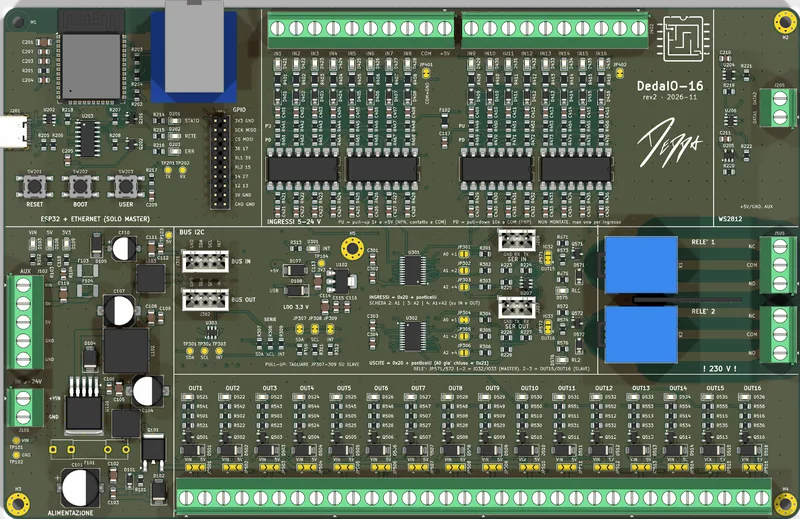
DedaIO-16 is an escape room prop controller born inside real rooms and built for any room: it runs doors, electronic locks, button panels and props, replacing hand-wired Arduino boards. Screw terminals for every signal, a status LED on every channel and a single 9-24 V supply: mount it in the cabinet, wire it and forget about it.
- 4-layer printed circuit board, industrial-grade components
- Power protection: fuse, reverse polarity, overvoltage
- Status LEDs for every input and output, plus network and error
- USB-C for the first upload, network updates afterwards
16 opto-isolated inputs
It senses everything your players do
Buttons, reed switches, limit switches, proximity sensors, light barriers, keys and dry contacts: every input accepts 5 to 24 V and is optically isolated from the microcontroller, so noise picked up by long cable runs stays outside.
- Optocoupler on every channel, two separable common groups
- On-board +5 V source for dry contacts
- Works with both NPN and PNP sensors
- One LED per input: check your wiring at a glance
16 outputs + 2 relays
It opens, lights up, moves
Maglocks, solenoids, electromagnets, lights, motors, smoke and sound: the 16 MOSFET outputs drive loads up to 2 A at 12/24 V or 5 V, selectable channel by channel, with the flyback diode already on board for coils and locks. For anything that must be isolated from the board there are two relays with COM, NO and NC contacts.
- Low-side outputs with LEDs, load voltage selectable per channel
- 2 changeover relays, driven directly by the microcontroller
- 2 outputs for WS2812 addressable LED strips (5 V)
- Controlled by the game, or forced manually from the app for testing
ESP32 + wired Ethernet
On the room network, by cable
In escape rooms Wi-Fi is crowded and walls are thick: DedaIO-16 uses wired Ethernet (W5500) with the reliability of a cable. The board announces itself on the network, gets its address via DHCP or a static IP, and recovers on its own thanks to the watchdog. The ESP32 also has Wi-Fi and Bluetooth LE on board: we don't use them today, but they are there for custom firmware.
- Dual-core ESP32-WROOM-32E, 8 MB flash
- 10/100 Ethernet with static IP or DHCP
- Built-in 2.4 GHz Wi-Fi and Bluetooth LE (not used by the standard firmware)
- Automatic discovery of boards on the network
- Watchdog and factory reset from the push button
Expandable
Up to 64 inputs and 64 outputs behind one IP
When the puzzle grows, the board grows with it: chain up to three slave boards with a 4-wire cable on the I2C bus. The Ethernet master sees every channel as its own, and your game software keeps talking to a single device.
- Up to 4 boards in a chain: 1 master and 3 slaves
- Dedicated BUS IN and BUS OUT connectors
- SER IN and SER OUT serial ports to chain several masters, with only one on the network
- Board address set with jumpers
Integration
Talks to your escape room software
DedaIO-16 connects to any management software or game master that can use a TCP
connection: the board exposes a documented line-based JSON protocol and can also connect
to your game server by itself and receive on, off and
reset commands.
# the game master switches OUT4 on (TCP 4211, one JSON line)
→ {"id":7,"c":"set_out","b":1,"i":3,"mode":"on"}
← {"t":"res","id":7,"ok":true}
# event pushed by the board
← {"t":"ev","k":"io","x":"door sensor (IN5) triggered"}- Native TCP: control, real-time status and events
- TCP client to your game server, with automatic reconnection
- REST/HTTP, MQTT or proprietary protocols with dedicated firmware
- Protocol documentation included
DedaIO management app
Every board in the room, in one window
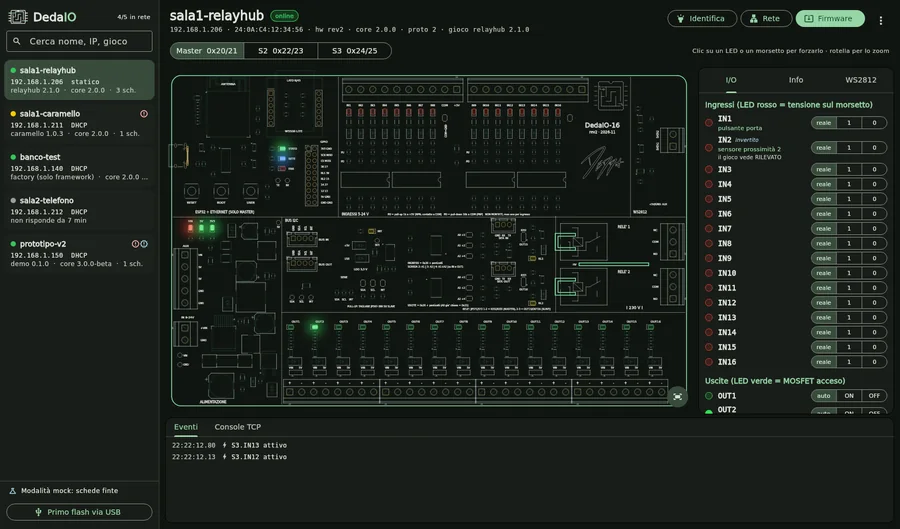
The DedaIO app finds the boards on the network by itself, shows the live state of inputs and outputs on a drawing of the board and lets you force every channel to test the wiring. It runs on Linux, Windows and macOS and also opens in a tablet browser, with nothing to install.
- Live status of inputs, outputs and LED strips
- Meaningful names for every channel: "door sensor", "display case magnet"
- Event log and board console
- Over-the-network firmware updates, one board or all of them
Discover the DedaIO app and block-based games →
Custom firmware
Your puzzle, our experience
Every room is different, so the firmware is versatile: underneath sits DedaIO Core, a solid framework that takes care of networking, updates and safety; on top runs the logic of each individual game.
We build it
Tell us about your puzzle: we write and test the firmware on commission and deliver it ready to upload from the app.
You build it
With DedaIO Core you only write the game: a few C++ functions such as
in(IN1), out(OUT3, true) and server_send().
Datasheet
DedaIO-16 specifications
| Microcontroller | ESP32-WROOM-32E, 8 MB flash, OTA updates |
|---|---|
| Network | 10/100 Ethernet (W5500), DHCP or static IP |
| Radio | ESP32 2.4 GHz 802.11 b/g/n Wi-Fi and Bluetooth LE, available but not used by the standard firmware |
| Inputs | 16 opto-isolated, 5-24 V, NPN/PNP, one LED per channel |
| Outputs | 16 low-side MOSFET up to 2 A, load at VIN or 5 V per channel, flyback diode and LED per channel |
| Relays | 2, COM/NO/NC contacts, driven by the ESP32 |
| Addressable LEDs | 2 WS2812 outputs, 5 V |
| Expansion | I2C bus, up to 4 boards (64 inputs, 64 outputs) |
| Board-to-board serial | SER IN / SER OUT, 3.3 V TTL on 3-pin JST, to chain several masters |
| Power supply | 9-24 V DC, fuse, reverse-polarity and overvoltage protection |
| Programming | USB-C for the first upload, then over the network |
| Protocols | JSON over TCP, TCP client to the game server, TCP console; others on request |
| PCB | 4-layer, 218 × 140 mm, screw terminals |
| Price | made to order: slave from €80, master (ESP32 and Ethernet) from €120; custom game firmware quoted separately |
FAQ
Before you get in touch
Does DedaIO-16 work with my escape room software?
Yes, as long as your software can open a TCP connection to devices or accept one. The board speaks a documented line-based JSON protocol over TCP and can also connect to your game server by itself. For REST/HTTP, MQTT or proprietary protocols we build a dedicated firmware.
Do I need to know how to program?
No. We can write the puzzle logic for you on commission. If you prefer to do it yourself, the DedaIO Core framework exposes a few C++ functions to read inputs, drive outputs and talk to the server.
How many inputs and outputs can I control?
One board has 16 inputs, 16 outputs and 2 relays. By chaining up to three slave boards on the I2C bus you get 64 inputs and 64 outputs behind a single IP address.
How is the firmware updated?
Over the network (OTA) from the DedaIO management app, without opening the control cabinet; the first upload is done over USB-C.
Can I use it instead of an Arduino in my escape room?
Yes: it does what is usually done with an Arduino, relays and loose modules, but on a single board ready for the cabinet, with opto-isolated inputs, protected power outputs, screw terminals, wired networking and over-the-network updates. You program it in C++ with DedaIO Core, or we write the puzzle firmware for you.
Can it drive maglocks and electric strikes?
Yes. Every output handles up to 2 A at 12/24 V (or 5 V) and already has a flyback diode, so maglocks, electric strikes, solenoids and valves connect directly. Two relays are there for loads that must be isolated.
Is it only for escape rooms?
No: it fits anywhere you need networked sensors and actuators, such as interactive museums and exhibitions, installations, stage props, shop windows and prototypes.
What power supply does it need?
Any DC voltage from 9 to 24 V. The board is protected by a fuse, reverse-polarity and overvoltage protection and generates its own 5 V and 3.3 V rails.
About us
Electronics born in Genoa
Behind DedaIO is DEDDA, a small business in Genoa, Italy, driven by a passion for electronics. It all started when a friend asked us for a board for their escape room: that first board turned into a collaboration, and the collaboration turned into DedaIO-16.
The first boards were made by hand, one circuit at a time. Today the PCBs come from industrial production, while assembly and software are made in Italy.
- Design, assembly and software in Genoa
- Industrially manufactured 4-layer PCBs
- Born inside a real escape room, proven in the field
- You talk directly to the people who designed the board
Got a puzzle to automate?
Tell us about your room: we will suggest the boards you need and, if you like, the firmware ready for your game.